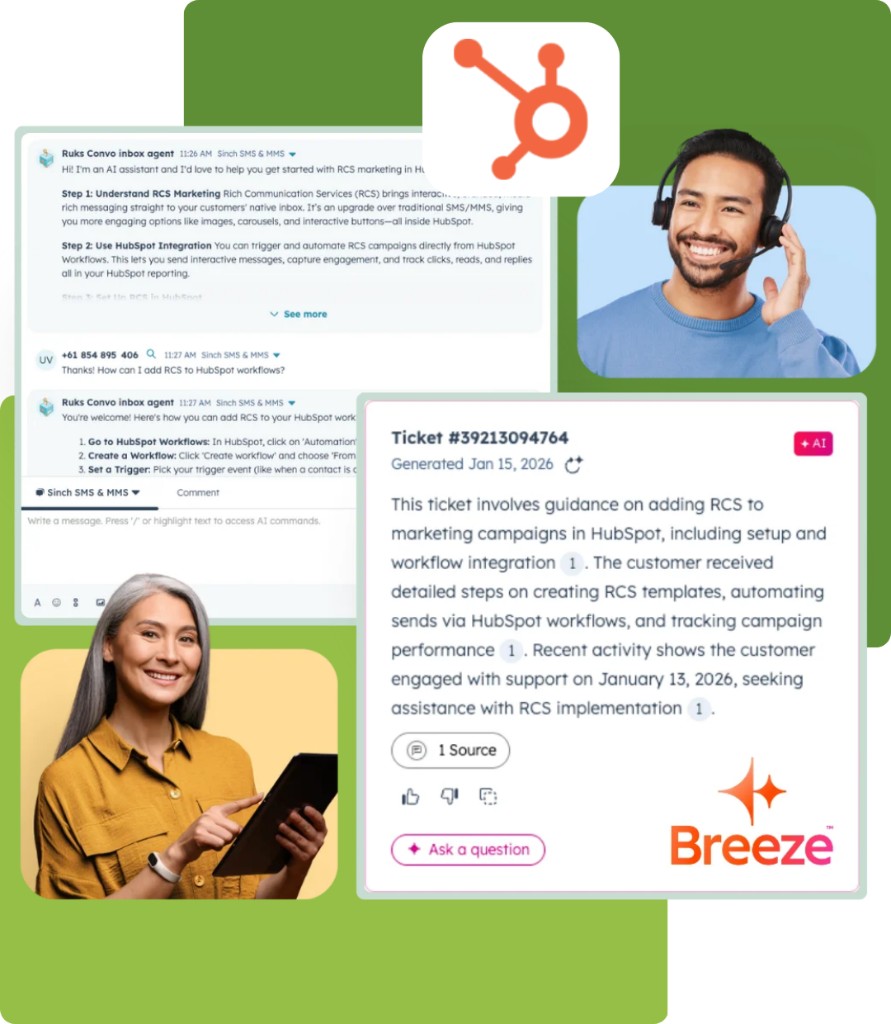
customer_success
Take on more customers without hiring more people
Across our client work, 65% of support is handled without a human. Help desk, customer success, and AI agents for DTC shoppers and wholesale buyers alike: the agent trains on the replies your team has already sent and is seeded from your own site and help content, so it answers in your voice, from the actual order, and hands over the ones that need a person.
70% less time per wholesale claim, pet nutrition manufacturer.Read the case study- Help desk build or rescue1-2 weeks
- Two-way Shopify syncincluded
- One inbox, routed, with response times that holdincluded
- Self-serve order status and returnsincluded
+2 more deliverables below
the_operations_bundle
Your team is answering from memory. That is the problem.
Not the helpdesk, not the headcount. When the order, the return, the last three tickets, and the account terms sit in four places, every reply is a small act of reconstruction. Put them in one place and the queue moves on its own.
customer_operations
4 included
Support is where most of our clients first feel the relief, because it is the function that quietly absorbs every other system being wrong.
fewer_tickets_at_the_source
The cheapest support ticket is the order a buyer places themselves
Most wholesale support volume is created upstream, by buyers who cannot see their pricing, their history, or their reorder without asking someone. A native Shopify B2B portal removes that class of question entirely, which is why we usually scope the portal and the desk together.
See the B2B portal work- Reduction in wholesale admin time
- 80%Reduction in wholesale admin time
- Stockists onboarded via the portal
- 100%Stockists onboarded via the portal
- Average order value versus prior
- 3xAverage order value versus prior
- Third-party apps required
- 0Third-party apps required
customer_success_automation
The tickets that never reach a person.
Most of what arrives after the sale is the same eight questions, and almost all of them are answerable from the order. Wired to Shopify, the routine ones resolve themselves, and the ones that do need your team arrive with the order, the return, and the account terms already attached.
- Replies with the order attachedThe ticket read against the real order so the draft is written in context, and nothing sends until one of your team approves it.
- Routing and triageWholesale to the account manager, damage claims to the person who handles carriers, everything else to the queue that owns it.
- Order status and tracking answersWhere is my order is the single most common ticket in e-commerce and the one least worth a human. It answers itself from the fulfilment record.
- Returns and exchange updatesStatus pushed as it changes, so the follow-up ticket asking what happened to my return never gets written.
- Satisfaction surveys on resolutionFired when the ticket closes rather than in a monthly batch, while the customer still remembers the interaction.
- Review requests routed by scoreHappy customers sent to the public review, unhappy ones captured privately for follow-up before anything is published.
- Churn signals before the renewalFalling order frequency, unanswered emails, and support volume read together, so the save attempt happens while there is still something to save.
- Wholesale reorder promptsBuyers nudged on their own reorder rhythm, with their contract pricing and terms already applied to the basket.
Nothing runs unattended by default. Every automation asks before it acts until you have watched it work, and anything we run can be paused the same day you ask.
Talk to us about support automationsymptoms
The problem
“Where is my order? We ask for the number every single time.”
Support works in one tab and the store in another, so every reply starts by asking for something the shopper or the dealer already gave you at checkout.
“Tickets live in a shared mailbox nobody owns.”
Two people answer the same email, another sits for three days, and there is no record of what was promised to whom.
“We tried an AI chatbot and it made things worse.”
It answered from a help article instead of the order, so customers repeated themselves to a human anyway and trusted the next reply less.
watch_it_answer
This is what a ticket looks like when the order is attached
Across our client work, 65% of support handled without a human. These are the two mechanisms doing it. On the left, the AI drafts a reply from the real order and a person approves it. On the right, the customer-facing AI agent handles the 2am question itself and hands over the one it should not answer.
Hi, my order has not arrived and I need it before Friday. Can you help?
order record · synced from shopify
#4127 · 2 items · UPS · in transit · arrives Thu
ai_draft · written from the order record
Good news: your order is with UPS and on schedule to arrive Thursday, a day before you need it. Here is the live tracking link. If anything changes, we will tell you before you have to ask.
Where is my order?
Your order shipped yesterday with Canada Post and is due Monday. Here is the tracking link. Want me to start a return or an exchange instead?
Actually the box arrived damaged.
Sorry about that. I have opened a damage claim and routed it to the person who handles carrier claims, with your order and this conversation attached. You will hear from them in the morning.

deliverables
What you get
A support desk that opens with the order on screen, and agents that only speak when they can answer from real data.
Help desk build or rescue
1-2 weeksService Hub configured around how your team actually answers, or an existing portal cleaned up rather than replaced.
Two-way Shopify sync
Customers, orders, and product data flowing both directions with explicit field mapping and conflict rules.
One inbox, routed, with response times that hold
Email, chat, forms, and phone in one queue with ownership, priorities, and skill-based routing. Calls come with recording, transcription, and AI summaries, IVR sends the caller to the right person the first time, and escalation triggers before a customer has to chase you.
Self-serve order status and returns
The volume driver on the DTC side. Shoppers check delivery and start a return themselves at 2am, which is the cheapest ticket you will ever handle because nobody handles it.
AI agents grounded in order data
Breeze agents that answer from the actual order and hand off to a human with the full thread attached, never inventing a delivery date.
Team training and documentation
Role-based sessions plus written process docs, because adoption is where most implementations quietly fail.
free_first_step
Start with the free assessment
We look at your store with read-only access and put in writing where support load is coming from and what the storefront could answer on its own. If the fix is smaller than an engagement, the findings say so.
capacity_not_headcount
Absorb more orders without hiring another agent
Support headcount is usually the first cost that scales one-to-one with orders, whether those orders come from a dealer or a first-time shopper. It does not have to. The figures below come from published case studies on this site, one derived number that says so on its face, and one founder-attested figure from engagements not yet written up.
- Of support handled without a human
- 65%Of support handled without a humanFounder-attested · across client engagements
- Less time spent handling each wholesale claim
- 70%Less time spent handling each wholesale claimPet Nutrition Manufacturer · B2B
- Claim volume the same team can absorb, derived from the 70% figure
- 3xClaim volume the same team can absorb, derived from the 70% figureArithmetic, not a measured result
- Tickets lost to personal inboxes after consolidation
- 0Tickets lost to personal inboxes after consolidationPet Nutrition Manufacturer · B2B
- Self-serve booking that consumes no staff hours
- 24/7Self-serve booking that consumes no staff hoursWellness Studio · DTC
- Fewer no-shows once reminders stopped being manual
- 50%Fewer no-shows once reminders stopped being manualWellness Studio · DTC
The 3x is straight arithmetic: if each claim takes 30 percent of the time it used to, the same hours cover a little over three times the volume before anyone needs to hire. The same logic runs on the consumer side, where the lever is deflection rather than speed, since an order status a shopper can check at 2am is a ticket nobody answers. Your mix will differ, which is what we measure during the audit rather than promise up front.
connected_systems
Systems we connect for this
proof
E-Commerce Customer Service Automation case studies

- 90days, two scopes
Pet Nutrition Manufacturer
A centralized HubSpot help desk and a D2C organic foundation delivered as two scopes in 90 days.
Read the case study - Lessspend, more booked
Wellness Studio
A local demand engine with CRM-integrated booking that lifted bookings on less ad spend.
Read the case study
questions
E-Commerce Customer Service Automation FAQs
What is help desk automation?
Help desk automation is everything a support desk does without a person touching the ticket: routing by type, drafting replies, answering order status from the fulfilment record, and letting shoppers start returns themselves. In an e-commerce desk the raw material is the order, which is why automation that is not wired to the store plateaus at canned responses. Across our client work, 65% of support is handled without a human, and the rest arrives with the order, the history, and the account terms already attached.
What makes e-commerce customer service different?
The order. A generic help desk treats every conversation as text to be answered; an e-commerce desk answers from data: where the order is, what is in it, what the customer paid, whether it is wholesale on terms or DTC. Most post-purchase tickets are the same eight questions, and almost all of them are answerable from the order record, which is why we wire the desk to Shopify before automating anything on top of it.
Do you work with Zendesk, or only HubSpot?
Both. We build support desks on HubSpot Service Hub, and we connect Zendesk to Shopify for brands already running it, syncing orders, customers, and fulfillments so agents answer from the order instead of asking for the number. The desk matters less than what it can see: an agent looking at a ticket with no order attached is guessing whichever logo is on the screen. The AI agent layer we build runs on HubSpot Breeze, so a Zendesk desk gets the Shopify connection and the order-grounded context rather than the agents. If you are already on Zendesk and it works for your team, the honest first step is wiring it to the store rather than migrating you.
Will AI agents replace our support team?
No, and you should be sceptical of anyone selling that. Agents are good at the repetitive volume, order status, delivery windows, returns policy, because those answers exist in your data and can be checked. They are bad at judgement, exceptions, and anything where a customer is already annoyed. We set them to answer only what they can ground in a real order and to hand off with the full thread attached, which usually means your team stops typing the same three replies and spends that time on the cases that actually need a person.
How long until the team actually uses it?
Implementation is four to six weeks. Adoption depends almost entirely on whether the people using it were consulted during design, which is why we run role-based training rather than one generic session and write process documentation your team can reference later. The pattern that fails is a technically perfect portal handed over with a recorded demo. Expect real usage over the first two months, with a check-in to fix what people are working around.
What if our data is a mess right now?
That is the normal starting point and it is dealt with in the audit phase rather than ignored. Deduplication, property consolidation, and deciding what not to migrate all happen before the sync is switched on, because importing bad data into a clean system just produces a clean system with bad data. Some historical records genuinely are not worth cleaning, and we will recommend archiving rather than migrating them.
next_step
Watch your own queue shrink
Bring us a week of tickets, or just your store URL. We map what would answer itself from the order and send the findings in writing.