
Make reordering easy for wholesale buyers.
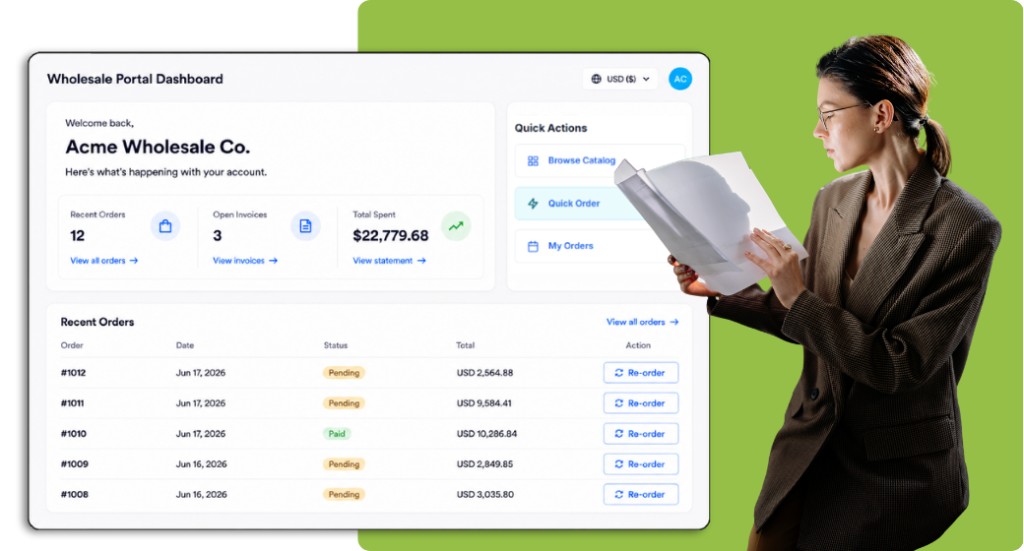
Give wholesale customers their prices and an easy way to buy again, with fewer emails and orders to retype.
2 currencies live at checkout and payout, wholesale portal work.Read the case study- Buyers can order for themselves
- Buy at your agreed price
- Pay on agreed terms
- Faster repeat orders
Built around your business
3 questions. No email needed.
Could your buyers order without the emails?
Find where to make a wholesale order easier.
More orders. Less back-and-forth.
- 01
“Our reps spend mornings retyping orders.”
Give them more time with customers and fewer chances to get an order wrong.
- 02
“Only one person knows each customer’s price.”
Buyers should see their agreed price even when that person is away.
- 03
“Customers still ask us for an order form.”
Make reordering as easy as choosing what they bought last time.
Easy for buyers. Easier on your team.
Let customers place their usual order without waiting for a reply.
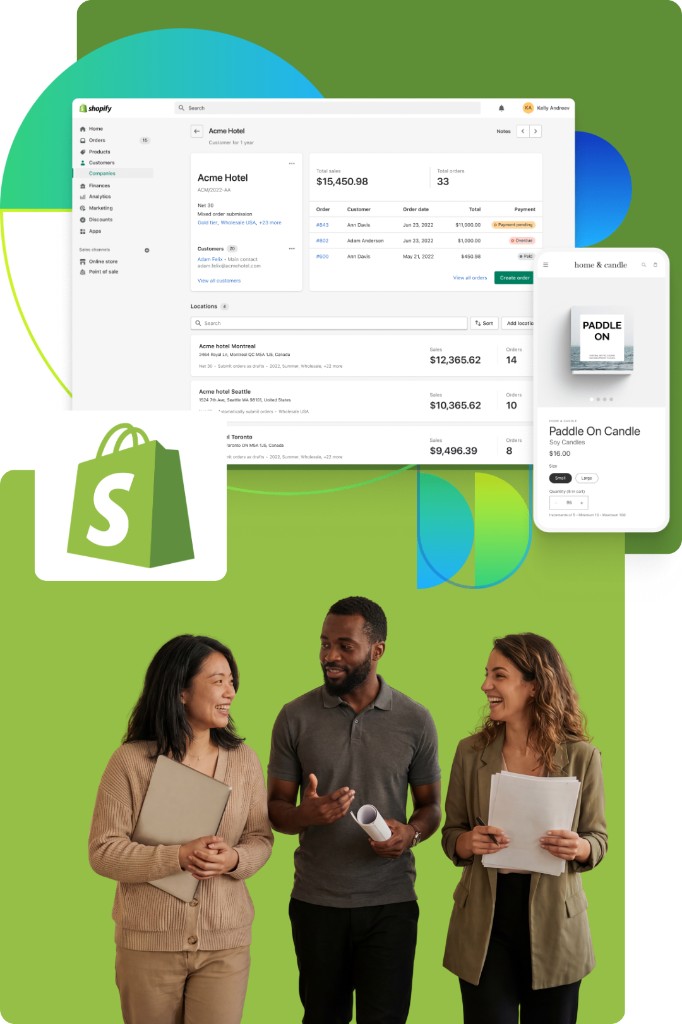

Connect the whole order process
One team connects your portal, pricing, freight and support.
Could your buyers order without the emails?
Find where to make a wholesale order easier.
What happens after the order
Handle the questions that come after an order
Buyers still need help with short shipments, damaged pallets and invoices. Connect customer and order history so your team can understand the account and take the next step.
See how wholesale support scalesWe work with the tools your team already uses. And when you adopt something new, we manage the change.
Including Gmail, Shopify, Mailchimp, Zapier, Google Ads, Slack, HubSpot, Klaviyo.
See all integrations







Shopify B2B Wholesale Portal Development FAQs
What does B2B portal development actually involve?
A Shopify B2B portal includes company accounts, buyer roles, customer price lists, payment terms and reordering. Most of this is configuration. Custom work covers ERP pricing rules, customer-specific catalog access and data sync. A typical portal takes weeks, rather than requiring a new platform built from scratch.
Is Shopify a good wholesale ecommerce platform?
For most manufacturers, wholesalers and distributors, yes. Wholesale and retail share one catalog, inventory pool and admin. Complex conditional pricing, quote-to-order processes and products with dependent options need closer review. We assess your catalog before you commit. Sometimes the best approach is to keep pricing in your ERP and show it through Shopify.
Do we need Shopify Plus for B2B?
Not always. Shopify B2B is available on Basic, Grow, Advanced and Plus. Plus adds features such as catalogs assigned directly to individual companies and more advanced payment options. We check your pricing, ordering rules and current plan before recommending an upgrade or an app.
Can we run wholesale and retail on the same store?
Yes. Wholesale buyers can log in for their prices while retail customers keep shopping as usual. We test your actual products, apps, tax and shipping rules before choosing the setup. The aim is to avoid duplicate catalogs and extra work for your team.
How do net terms work if our ERP holds the credit limit?
We sync credit limits and current balances from your ERP so checkout can enforce them. Buyers over their limit receive a clear message and cannot place the order. The ERP remains the main source for credit data; Shopify reads it.
What if our pricing is genuinely complicated?
Volume discounts, company and contract pricing, and multiple currencies are standard requirements. Pricing calculated live in your ERP needs more work. For example, freight-inclusive prices that vary by destination and weight need a live pricing request from the cart. We can build that, but quote it separately from loading price lists.
Will our sales reps lose visibility into their accounts?
With the right setup, reps can view their accounts, place orders for buyers and see order history in one place. We also record rep attribution on portal orders for commission tracking. Self-serve reordering usually gives reps more time to sell by reducing data entry.
How long before buyers actually use it?
Timing depends on your pricing, data and integrations. We test with a small group of real buyers before a wider rollout: can they sign in, see the right products, reorder and understand shipping? Your team learns how to help buyers and update account rules. We agree the build and rollout schedule in the scope.
Make wholesale easier to run.
Tell us where orders slow down, and we’ll help you find a simpler way.